CapEx Strategy
Why the "10% CapEx Rule" Fails Landlords (And What to Do Instead)
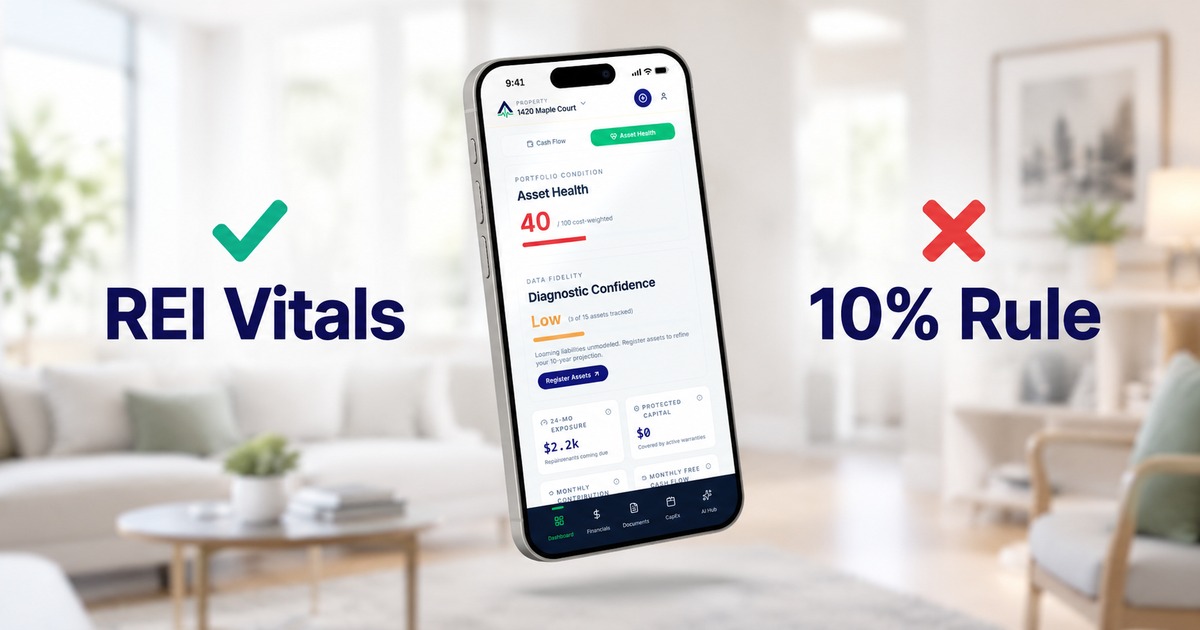
Your cash flow statement looks pristine right up until an eighteen-year-old heat pump fails during a July heatwave.
Most real estate forums offer the same lazy prescription for major replacements: set aside 8% to 10% of gross monthly rent and hope for the best. If you manage your properties with a data-driven mindset, that math should bother you immediately.
A furnace replacement in Columbus costs roughly $5,200 whether the unit rents for $1,100 or $1,900. Your physical capital systems do not care about your rent roll. They degrade strictly against time, usage, and local weather.
Here is why static rules of thumb fail, and how institutional investors model physical risk instead.
The flaw in percentage-based reserves
Percentage rules assume risk scales with top-line revenue. In reality, capital liability is dictated by equipment age and local contractor pricing.
| Reserve strategy | The "10% of rent" rule | REI Vitals Asset Health model |
|---|---|---|
| How it calculates risk | Blindly multiplies gross rent ($1,800/mo = $180/mo reserve) | Audits the actual install dates and lifespans of your major systems |
| Aging properties | Underfunds older properties where mechanicals are nearing end-of-life | Flags expired systems immediately and calculates catch-up sinking funds |
| Turnkey properties | Traps thousands in idle cash while all components are under warranty | Lowers reserve targets when systems are new, keeping capital productive |
| Capital collision visibility | Zero visibility until two systems fail in the same season | Forecasts multi-asset cliffs on an interactive 10-year timeline |
| The result | Surprise capital calls and credit card debt | Precision reserves ready before the work order arrives |
Tying reserves to top-line rent either leaves you vulnerable to emergency capital calls or needlessly locks up working capital.
Layer 1: The Asset Health Registry
Institutional operators do not guess when capital expenses will hit. They maintain a living equipment register for every address in their portfolio. An Asset Health Registry catalogs every physical system, its installation date, expected useful life, and current local replacement cost.
| System | Installed | Useful life | Remaining | Est. replacement |
|---|---|---|---|---|
| Asphalt shingle roof | 2011 | 25 yrs | 10 yrs | $11,800 |
| HVAC heat pump | 2009 | 15 yrs | Expired | $6,400 |
| Water heater | 2021 | 10 yrs | 5 yrs | $1,650 |
| Plumbing fixtures | 2018 | 20 yrs | 12 yrs | $3,200 |
| Current exposure | $23,050 |
Example property: 412 Maple Ave, built 2008.
With this register in place, you instantly eliminate unexpected surprises:
- Explicit replacement horizons: You see exactly which systems have entered their terminal quadrant before a tenant submits an emergency work order.
- True sinking fund schedules: Rather than saving a random flat dollar amount, each asset gets an exact monthly accumulation rate.
Monthly sinking target
Estimated replacement cost ÷ Remaining useful life (months)
Layer 2: The 10-Year Funding Target
Traditional landlord software draws a straight, flat savings line across time. Real estate capital expenditures do not happen in smooth lines. They occur as discrete sawtooth events.
10-year target reserve projection
Amber dots mark replacements due (resets next year).
When you plot your assets across a ten-year timeline, capital events often cluster together. A water heater and an air handler installed in the same renovation cycle will likely expire in the same twenty-four-month window.
A dynamic 10-Year Funding Target delivers three clear advantages:
- Collision detection: Spots multi-asset failure cliffs years in advance so you can phase replacements deliberately.
- Capital efficiency: Keeps reserves high when failure risk peaks, but drops the required balance after an asset is replaced. You avoid parking twenty thousand dollars of dead cash in a low-yield savings account when your entire mechanical suite is brand new.
- Underwriting transparency: When refinancing or selling, you hand lenders and buyers an institutional-grade capital plan rather than a vague napkin estimate.
The shift from reactive to predictive
Running rental properties does not require enterprise accounting teams, but it does require moving past folklore heuristics.
| Traditional reactive landlord | Analytical asset manager |
|---|---|
| Sets aside an arbitrary 10% of monthly rent | Models reserves based on exact asset age and local costs |
| Surprised when HVAC and water heater fail in the same month | Tracks lifecycle horizons inside a digital registry |
| Relies on credit cards or out-of-pocket capital calls | Accumulates sinking funds aligned with a 10-year curve |
| Treats maintenance and capital expense as identical line items | Isolates OpEx from long-term capital preservation |
Your properties are physical engines. If you want predictable returns, monitor your equipment with the same rigor you apply to your lease agreements.
Next steps for your portfolio
- Test your current numbers on our free CapEx Calculator to see your 10-year reserve projection.
- Ready to build your digital asset registry? Start your 14-day free trial on REI Vitals.